Hejduk Lamp
Runxin Fu
Furniture / Product Design · 2024
NYADW 2026 — Traces of Force
Gallery 456 · Aug 7–21
Acquisition
Price Upon Request
Project Statement
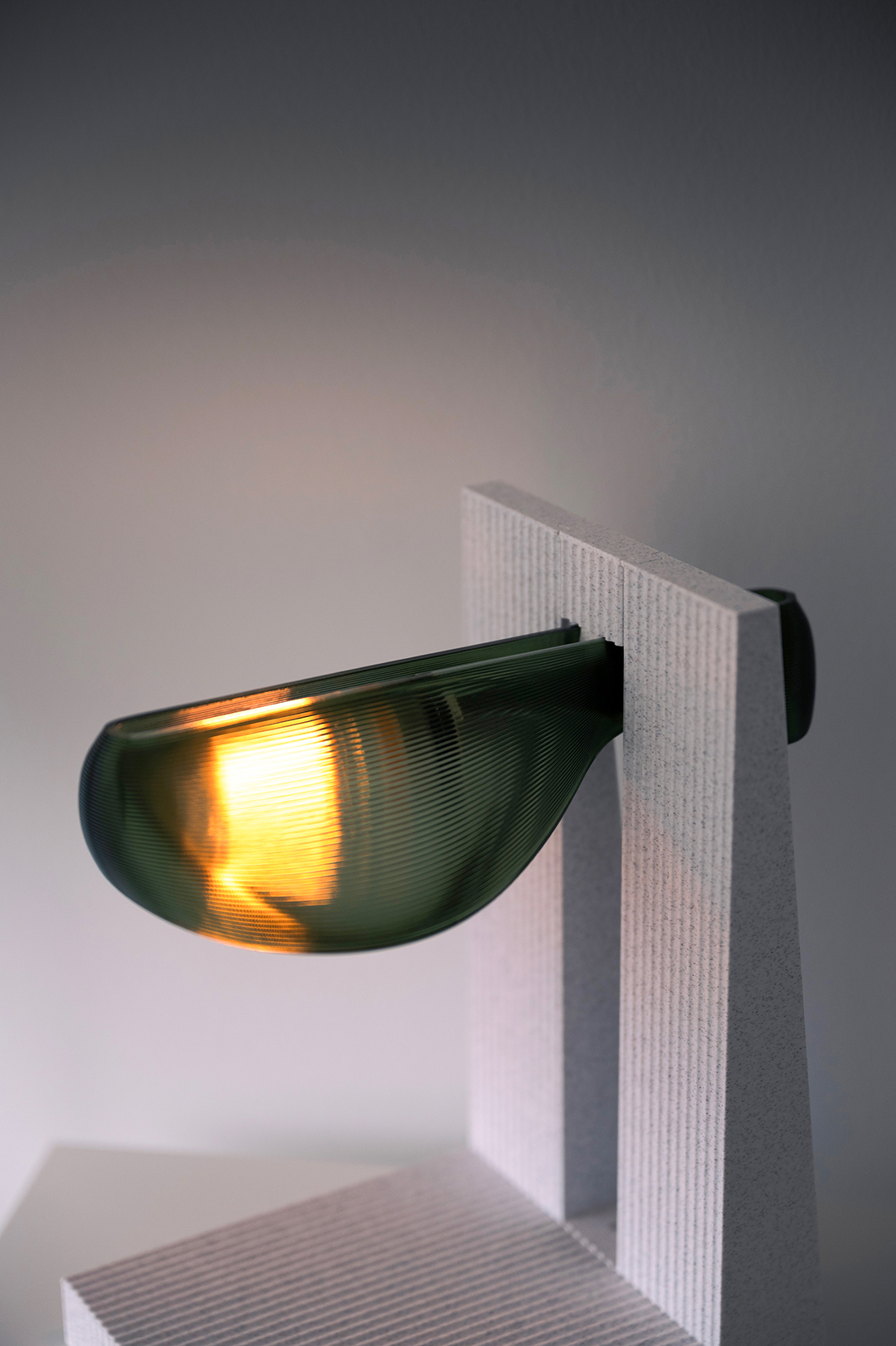
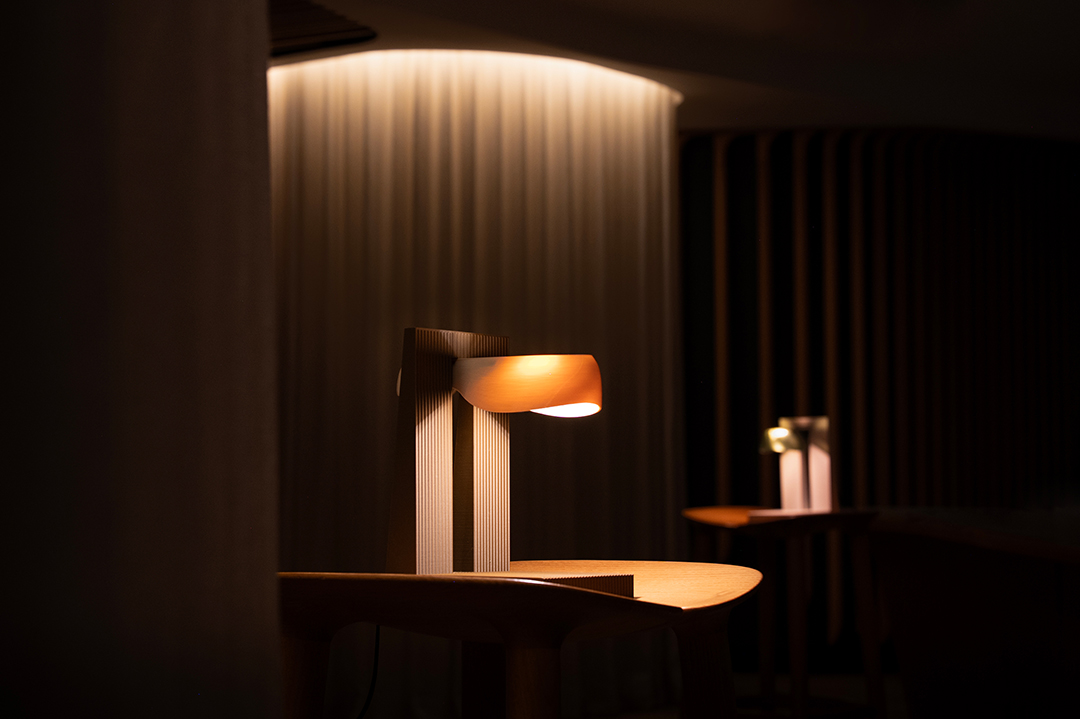
John Hejduk's Wall House II is a building organized around a fundamental duality: the wall as both separator and connector, the threshold as the site where separation and passage coexist. The house does not resolve this tension — it inhabits it. Hejduk Lamp begins there, translating that architectural condition into the scale and material logic of a lamp.
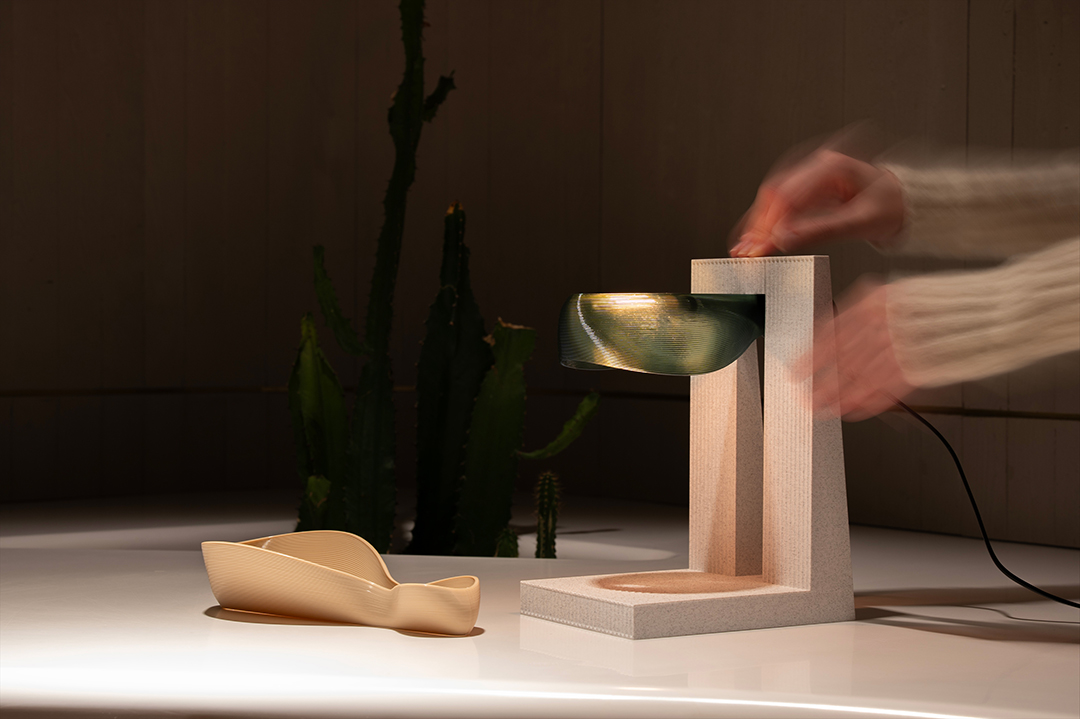
The lamp is constructed through non-planar 3D printing, a process in which the print head moves through space along G-code paths choreographed to produce forms that cannot be achieved by standard layer-by-layer FDM. The structural component — the chassis — is printed conventionally, providing rigidity. The non-planar surfaces, which constitute the lamp's visual presence, emerge from the choreographed deviation: surfaces that curve, fold, and inflect in ways that register the force of the tool path as form.
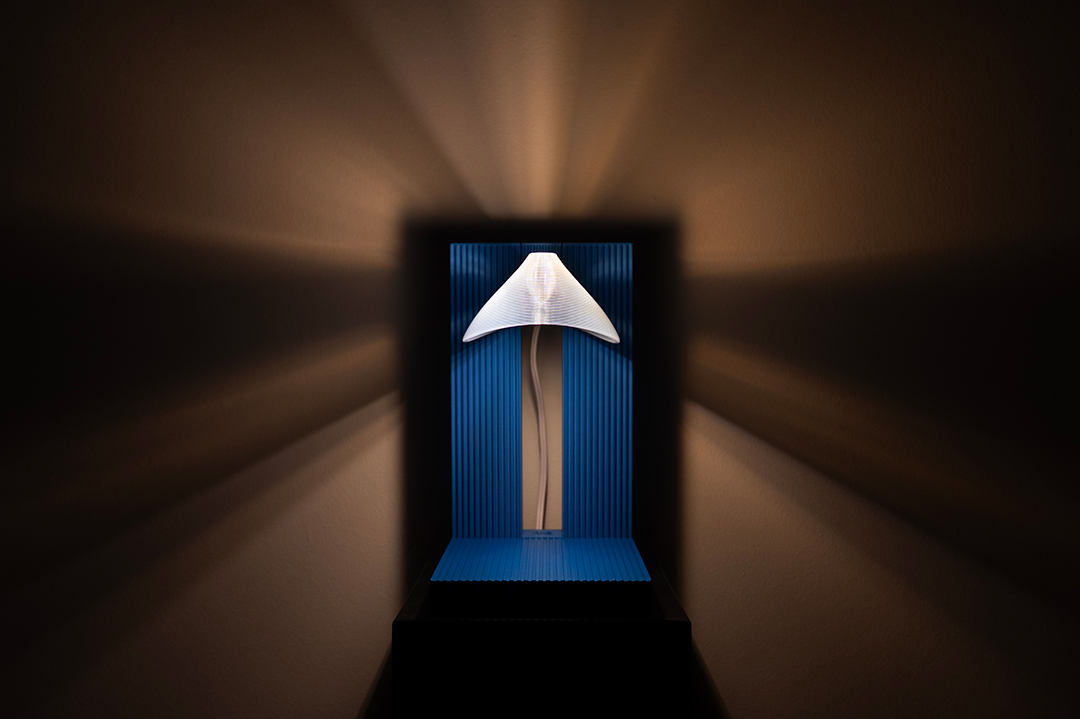
The project is available in eight palettes, each shifting the lamp's relationship to light and material presence. Parts are designed to be modular and replaceable, supporting a closed-loop recycling model in which worn or damaged components can be returned, reprocessed, and reissued rather than discarded. The lamp's assembly logic is inseparable from its sustainability logic: the same modularity that allows color variation allows material recovery.
What the lamp inherits from Hejduk is not the image of the Wall House but its insistence that a clear formal idea — isolation and connection, separation and passage — can generate a complete object. The wall is here a surface that admits and withholds light simultaneously. The lamp does not illuminate a room evenly; it creates a condition.
Gallery
Runxin Fu is an architect and designer based in New York. He holds a Master of Science in Advanced Architectural Design (MSAAD) from Columbia University GSAPP and a Bachelor of Architecture from Harbin Institute of Technology. His practice operates across architecture, product design, and fabrication research, with a sustained interest in how digital manufacturing processes — particularly non-planar 3D printing and robotic fabrication — can produce forms that carry the trace of their making.
Fu is the founder of PreTangia studio and the Lr. Design brand, through which he develops objects and interiors that apply advanced fabrication techniques to the constraints and pleasures of everyday use. His work engages with sustainability not as a set of materials substitutions but as a design logic: modularity, repairability, and closed-loop material recovery built into the object's structure from the outset.
Opening Reception
Friday, August 7, 2026
6:00–9:00 PM — Gallery 456
Free and open to all. Join us to experience Traces of Force in person.
RSVP for the OpeningThis project is made possible in part with funds from Creative Engagement, a regrant program supported by the New York City Department of Cultural Affairs in partnership with the City Council, and the New York State Council on the Arts with the support of the Office of the Governor and the New York State Legislature, and administered by the Lower Manhattan Cultural Council.